|

 Summary Summary
In 2000, the Company continued
its focus on expanding core businesses by both internal investment and
acquisitions. Capital expenditures for 2000 were $100.4 million compared
to $137.4 million in 1999 and $139.8 million in 1998. Throughout this
three-year period, the Company has focused on building and expanding its
manufacturing capacity to support its technological strengths. In addition
to this aggressive internal capital investment, the Company also invested
heavily in business acquisitions.
On September 8, 2000, the Company
purchased the pressure sensitive materials product line of Kanzaki Specialty
Papers, Inc., which had approximately $78.0 million in net sales in 1999.
This business supplies direct thermal pressure sensitive products to printers
for labels used for bar coding, shipping and inventory labeling, and a
variety of other end uses. This acquisition provides a significant new
product line in the Company’s Pressure Sensitive Materials segment.
On August 31, 2000, the Company
purchased the specialty plastic films business of Viskase Companies, Inc.,
which supplies a variety of shrinkable barrier bags, films, and cook-in
bags to beef, pork, poultry, and cheese processors. It had net sales of
approximately $150.0 million in 1999. This acquisition has complex technologies
that both complement and extend the technologies employed in the Company’s
very successful flexible packaging business. In addition, this acquisition
brings to the Company immediate access to important fresh meat markets
and is a natural extension of the strong position and relationships already
established in the processed meat, cheese, and poultry markets. Included
in the acquisition are manufacturing facilities in Centerville, Iowa;
Pauls Valley, Oklahoma; Swansea, Wales; and São Paulo, Brazil.
Effective August 1, 2000, the Company
purchased the assets of the flexible packaging business of Arrow Industries,
which had net sales of approximately $33.0 million during the preceding
twelve months. Equipment acquired with this business is being strategically
deployed into existing facilities to provide additional capacity.
On January 6, 2000, the Company
purchased the remaining 13 percent minority interest in Morgan Adhesives
Company (MACtac). The Company issued 1,730,952 shares of its common stock
and paid $3.4 million in cash. Upon the acquisition of these minority
shares, MACtac became a wholly-owned subsidiary of Bemis Company, Inc.
Overall results for 2000 produced
net sales of $2.16 billion compared to $1.96 billion and $1.89 billion
in 1999 and 1998, respectively. Net sales and cost of products sold have
been restated for all periods presented, in accordance with new accounting
guidance, for the reclassification of certain freight-out costs from a
reduction in net sales to cost of products sold. The net sales increase
of 10.3 percent in 2000, which occurred principally in the Flexible Packaging
segment, was led by strong unit volume growth in high barrier products.
Net income for 2000 totaled $130.6 million compared with $114.8 million
and $101.1 million for 1999 and 1998, respectively. Diluted earnings per
share were $2.44 for 2000, $2.18 for 1999, and $1.90 for 1998. Excluding
the effects of business acquisitions and dispositions, 2000 net sales
increased 6.2 percent from 1999 while operating profit increased 9.5 percent
from the 1999 level.
Net sales for the Flexible Packaging
segment increased 12.9 percent with operating profits increasing 18.2
percent from the levels achieved in 1999. Strong sales increases in high
barrier products and polyethylene products provided the base for improved
operating profits. Flexible Packaging operating profits were $221.3 million
in 2000, or 13.3 percent of net sales, compared to $187.2 million, or
12.7 percent of net sales in 1999, and $156.3 million, or 11.2 percent
of net sales in 1998. Increased unit sales and a continuing focus to lower
the cost structure largely account for the improvements in operating profit.
Net sales for the Pressure
Sensitive Materials segment increased 2.6 percent over the 1999
level. Operating profit, however, decreased 9.5 percent as this
business segment continued to face less favorable economic conditions
in North America, higher raw material costs, and increased price
competition in certain markets. Pressure Sensitive Materials operating
profits were $40.1 million in 2000, or 7.9 percent of net sales,
compared to $44.3 million, or 9.0 percent of net sales in 1999,
and $51.0 million, or 10.4 percent of net sales in 1998.
Return to Top
Outlook
In 2000, the Company took advantage of opportunities
to further strengthen core capabilities through several strategic
acquisitions. These acquisitions will increase our market share,
our customer base, and our technological resources, and introduce
us to new markets. The Company expects sales to continue to rise
six to eight percent annually over the next several years as our
Flexible Packaging business benefits from the continuing trend of
flexible packaging replacing rigid packaging and from the ongoing
consolidation of customers with which the Company has strong relationships.
Future acquisitions could further enhance sales growth. In 2001,
we expect some weakness in industrial markets served primarily by
our Pressure Sensitive Materials business and portions of our polyethylene
packaging product line. We expect, however, that with greater than
65 percent of our products used in the food industry, our exposure
to this market will limit the adverse impact of any downturn in
the economy.
Return to Top
Costs and Expenses
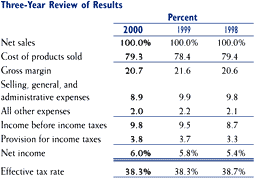
Cost of products sold as a percentage
of net sales was 79.3 percent for 2000 compared to 78.4 percent for 1999
and 79.4 percent for 1998. The increase experienced in 2000 was due to
increasing material costs which were partially offset by lower product
conversion and employee benefit costs.
Selling, general, and administrative
expenses decreased $1.5 million in absolute dollars in 2000 versus 1999
after increasing $8.0 million in 1999 versus 1998. Expressed as a percent
of net sales, selling, general, and administrative expenses were 8.9 percent,
9.9 percent, and 9.8 percent for 2000, 1999, and 1998 respectively. The
Company’s focus on improved cost control together with lower employee
benefit costs largely account for the improvements achieved in 2000.
Research and development expense was $10.1 million
in 2000, $11.7 million in 1999, and $12.2 million in 1998. The decrease
occurred principally within the Pressure Sensitive Materials segment resulting
from increased focus on internal efficiencies to assist in its efforts
to deal with less favorable economic conditions in North America and increased
price competition in certain markets.
A higher debt level in 2000 together with rising
interest rates, increased interest expense to $31.6 million compared to
$21.2 million in 1999 and $21.9 million in 1998. The increased debt level
during 2000 was principally due to business unit acquisitions and common
stock repurchases.
Other costs reflect expense of
$1.4 million for 2000 versus expense of $6.9 million and $0.3 million
in 1999 and 1998, respectively. The 1999 expense was principally due to
losses from our Brazilian joint venture that included $1.7 million for
currency losses and $2.6 million for relocation and reorganization costs.
The improved operating results from the joint venture are reflected in
the lower 2000 costs.
The reduction in minority interest is due to the
January 2000 purchase of the 13 percent minority interest in MACtac.
Upon the acquisition of these minority shares, MACtac became a wholly-owned
subsidiary of Bemis Company, Inc.
Return to Top
Return on Investment
Return on average stockholders’ equity
in 2000 was 17.1 percent compared to 16.2 percent in 1999
and 14.9 percent in 1998.
Operating profit as a percent of average
investment was 16.8 percent in 2000 compared to 18.6 percent in
1999
and 17.1 percent in 1998.
Operating profit as a percent of
average investment for the Flexible Packaging segment was 17.2 percent
in 2000 compared to 18.6 percent in 1999 and 15.9 percent in 1998. This
same ratio for the Pressure Sensitive Materials segment was 14.6 percent
in 2000 compared to 18.7 percent in 1999 and 22.1 percent in 1998.
Return on average total capital was 10.8 percent
in 2000, 10.9 percent in 1999, and 10.3 percent in 1998. Total capital
is defined as the sum of all short-term and long-term interest-bearing
debt, including obligations under capital leases, stockholders’
equity, and deferred taxes. Return on total capital is based on
net income adjusted for interest expense on an after-tax basis.
Return to Top
|
 Business
 Financial
Statement
Financial
Statement






