|

Capital Expenditures
Capital expenditures in 2000 were
$100.4 million compared to $137.4 million in 1999 and $139.8 million in
1998, including capitalized interest of $1.7 million, $1.6 million, and
$1.3 million for 2000, 1999, and 1998, respectively. In 2001, management
anticipates expenditures in the $120 million range. The majority of these
expenditures, made from internally generated funds, will be for continued
expansion of the Company’s growth businesses, with major equipment
purchases planned for the Flexible Packaging segment in both high barrier
and polyethylene product lines.
Capital Structure, Liquidity,
and Cash Flow
Stockholders’ equity increased
in 2000 to $798.8 million, up from $725.9 million in 1999 and $687.9 million
in 1998, primarily due to earnings reduced by dividend payments and common
stock repurchases. In 2000, $42.8 million of common stock was repurchased
compared to $4.1 million in 1999 and $41.3 million in 1998. Common stock
totaling $0.48 million and $0.05 million was issued in 2000 and 1999,
respectively, in connection with the Company’s stock-based compensation
programs. Additionally, common stock totaling $54.8 million was issued
in 2000 in connection with the acquisition of the minority interest of
MACtac.
Total debt increased $293.7 million in 2000 to
$672.8 million, resulting in a total debt to total capital ratio
of 42.7 percent compared to 31.7 percent in 1999 and 32.8 percent
in 1998. The significant increase in 2000 is due to acquisitions
which primarily account for the $147.4 million increase in goodwill
and $103.2 million increase in intangible assets, deferred charges,
and other assets. In 2001, total debt is expected to decrease due
to continuing strong cash flow from operations.
 Working
capital (excluding short-term borrowings and the current portion of long-term
debt) increased by $42.6 million to $379.7 million in 2000 following an
increase of $29.3 million to $337.1 million in 1999 and a decrease of
$7.5 million to $307.8 million in 1998. The current ratio was 1.3:1 in
2000 compared to 2.3:1 in 1999 and 2.2:1 in 1998, reflecting the short-term
debt increase in 2000 associated with acquisitions. Working
capital (excluding short-term borrowings and the current portion of long-term
debt) increased by $42.6 million to $379.7 million in 2000 following an
increase of $29.3 million to $337.1 million in 1999 and a decrease of
$7.5 million to $307.8 million in 1998. The current ratio was 1.3:1 in
2000 compared to 2.3:1 in 1999 and 2.2:1 in 1998, reflecting the short-term
debt increase in 2000 associated with acquisitions.
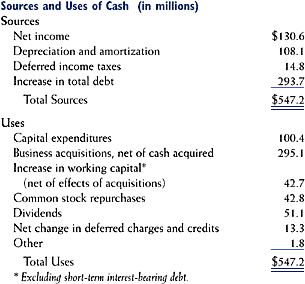
The Company’s cash flow remained
strong in 2000 as cash provided by operating activities was $210.2 million
compared to $186.1 million in 1999 and $234.6 million in 1998. The adjacent
schedule presents the major sources and uses of cash for the Company in
2000.
The Company’s pretax interest
coverage was 7.7 times in 2000 compared to 9.8 times in 1999 and 8.6 times
in 1998. Pretax income increased to $211.5 million in 2000 from $185.9
million in 1999 and $165.0 million in 1998. Interest expense was $31.6
million in 2000, $21.2 million in 1999, and $21.9 million in 1998. Following
are pretax interest coverage ratios for the last
five years:

At year-end 2000 the Company had
credit lines of $584 million, including a $334 million revolving credit
facility and a $250 million short-term bridge credit facility. These lines
are used primarily to support the Company’s issuance of commercial
paper which carries an A-1, P-1 rating. The Company also has the capability
of issuing up to approximately $100 million of Extendable Commercial Notes
(ECNs) which are short-term instruments whose maturity can be extended
to 390 days from the date of issuance. As of December 31, 2000, the Company
had $545 million of commercial paper outstanding. In January 2001, the
Company registered for issuance $250 million of debt securities with the
Securities and Exchange Commission.
Return to Top
|
 Business
 Financial
Statement
Financial
Statement






