|
7. Ozone Depleting Substances
Policy Commitment:
Avoiding the purchase and use of
environmentally damaging materials, including ozone depleting substances,
and preventing the release of pollutants
Environmental Management Programme
Objective:
To Replace Ozone Depleting Substances
With Suitable Alternatives According To Legal Requirements
7.1 Introduction
to the Issue
Manufacture and sale of ozone depleting
substances (ODSs) – particularly chlorofluorocarbons (CFCs), hydrochlorofluorocarbons
(HCFCs) and halons have been restricted internationally through the Montreal
Protocol, and in the UK by subsequent legislation. From 1 October
2000, there has been a ban on the sale and use of most CFCs, carbon tetrachloride
and 1,1,1, trichloroethane. These substances are primarily used as
refrigerants, solvents and in dry cleaning, although there are some exemptions.
The halons used in firefighting (1211
and 1301) will continue to be available until the end of 2002, but most
systems will have to be decommissioned by the end of the following year.
Our fire extinguishing (flood) systems,
refrigerants for chillers, air conditioning units and chlorinated solvent
degreasers are common sources of ODSs.
7.2 Current
BSkyB Status
We currently use a number of different
refrigerants, some of which are classed as ozone depleting, and are being
phased out under the Montreal Protocol and its implementing regulations
in the UK. Other non-restricted substances are also used on our sites.
Recent new builds at our Osterley
site have incorporated water sprinkler systems not halon systems. However,
water systems are not generally appropriate for multiple small buildings,
which is the layout at some of our sites. In consequence, ODS alternatives
are being investigated. It is recognised that the cost, in terms
of replacing like-for-like, is increasing. This reflects the increasingly
restricted availability of ODS following the implementation of the Regulations.
In consequence, there are both environmental and cost grounds for us to
assess and reassess usage.
7.3 Performance
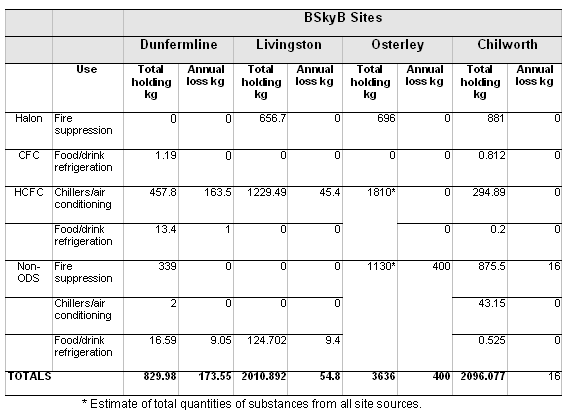
Data
7.4 Planned
Actions to Improve
| Action |
Target Date |
| Identify suitable alternatives and
options for replacement and determine target for phase out of the ODS. |
2002/03 |
| Draft a strategy and programme for
their replacement, taking into account the requirements of the relevant
legislation, and including costs (capital investment and other) and resources
required. Seek senior management approval. |
2002/03 |
| Begin to implement replacement programme
and record amounts replaced over time for reporting purposes. |
2002/03 |
7.5 Case Studies/Interesting
Facts
During 2001, we have built a new
uplink site at Fair Oak in Hampshire as a supplement to our Chilworth site.
The site has been built without the use of any ODSs in any of the systems.
The air conditioning systems installed contain a total of 30Kg of R407c
refrigerant and the fire suppressant systems a total of 330Kg of FM200.
We have also commenced the replacement
of all halon fire suppressant systems at our Chilworth site with non-ODS
alternatives. This work will be completed by February 2002 and will
result in the total elimination of halon from this site. The cost
to us of this change is £140,000.
|