

















 ur board test sales grew by
about 25 percent in 1998. Since the market for these systems increased
hardly at all, we gained significant market share in the year. Three factors
provided most of the impetus: First, sales of M910 and M920 digital test
units for the military market were up sharply, as the system count for
the Navy’s CASS program approached the 400 mark (out of a total of
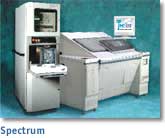
700 under the current contract). Second, the Spectrum family of in-circuit
and functional test systems, introduced in 1996, hit full stride in the
commercial market, especially among makers of telecommunications systems.
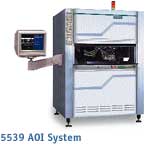
Third, the Company’s entries in the automatic optical inspection
(AOI) and “flying prober” markets were well received, with one
large manufacturer buying more than 40 AOI systems.
ur board test sales grew by
about 25 percent in 1998. Since the market for these systems increased
hardly at all, we gained significant market share in the year. Three factors
provided most of the impetus: First, sales of M910 and M920 digital test
units for the military market were up sharply, as the system count for
the Navy’s CASS program approached the 400 mark (out of a total of
700 under the current contract). Second, the Spectrum family of in-circuit
and functional test systems, introduced in 1996, hit full stride in the
commercial market, especially among makers of telecommunications systems.
Third, the Company’s entries in the automatic optical inspection
(AOI) and “flying prober” markets were well received, with one
large manufacturer buying more than 40 AOI systems.
Several new board test products were introduced in 1998, including a new functional test system, the Spectrum 9000. Functional testing has had its ups and downs over the years, and it is back in season, thanks to the increasing use of standard formats (VXI, Windows NT, etc.), which strengthen the economic case for investing in customized test solutions.
One of the more significant developments, and the recipient of a “Best in Test” industry award, was the TestStudio ATE operating environment, a software umbrella that simplifies the programming of Spectrum systems. Since the Web-based TestStudio can be accessed through an html browser, it also sets the stage for remote programming, remote data collection, and remote operation via the Internet. With the Spectrum product line now sharing a common programming system via TestStudio as well as common VXI-based backplanes, we can offer our customers an unprecedented degree of flexibility as changes in demand force them to adjust their test strategies and rebalance their production lines.
In 1996 we entered the optical inspection market by acquiring a small company called Control Automation. Although a product existed, its sales were negligible, and an engineering investment was required to bring a competitive product to market. The investment yielded excellent results in 1998, as Teradyne, previously a non-factor in the optical inspection market, suddenly found itself the world’s third largest supplier of such systems.
Similar success greeted our entry into the “flying prober” market, via a system designed in partnership with Japan’s Shindenshi Corporation and made by Shindenshi for us. The flying prober is an in-circuit tester that replaces the usual stationary mechanical “bed of nails” fixture with an array of moveable probes that “fly” around the tested board with lightning speed. The flexibility of such a system makes it especially attractive as a prototype tester, but in 1998 one creative customer came up with an ingenious technique for applying it to the production line. Strong sales of this product in 1998 made Teradyne the second largest factor in the market.
For several years our board test activities have been centered in two divisions: one, in Boston, supplying functional test systems, chiefly for the military market, the other, in Walnut Creek, California, focused on in-circuit testers for the commercial market. Now, as we move to standardize software and hardware platforms, the division of resources no longer makes sense, and in 1998 we combined the two units into a single Assembly Test Division under Joe Wrinn, a Teradyne veteran and most recently the manager of our Walnut Creek operation. The two groups will retain their east- and west-coast habitats, but in 1999 the Massachusetts group will leave downtown Boston to settle into Teradyne’s new campus in nearby North Reading.