


















 ales of software test products increased by about 80 percent in 1998.
Every one of our five business units working in this area grew, new products
were added, new talent was recruited, new space leased. While the group
still represents a small slice of the Company’s revenue pie, its
share is growing rapidly, and it is clearer than ever that this business
will play a major role in the Company’s future.
ales of software test products increased by about 80 percent in 1998.
Every one of our five business units working in this area grew, new products
were added, new talent was recruited, new space leased. While the group
still represents a small slice of the Company’s revenue pie, its
share is growing rapidly, and it is clearer than ever that this business
will play a major role in the Company’s future.
It is easy to see why this is so. Each generation of computer hardware brings a new wave of software. Then, as users find that they can’t run the new software on their old hardware, another computer cycle begins, followed by another software cycle. The holy grail is speed or, in communications terms, bandwidth, and all five of our software test units (as well as all our other businesses) are deeply involved in the chase.
How great is the potential for software test products? Consider this: More money was spent last year to address a single software problem (Y2K) than to test the world’s entire output of semiconductors. Not every problem is as threatening as Y2K, but as more and more “mission-critical” software invades our daily lives, the costs of defects will soar, and the pressure will mount for better testing. Automated test techniques such as those being developed by Teradyne will then inevitably replace most of today’s manual testing, first for the most critical software, then, as the tools are refined and costs fall, for the entire software industry.
The largest and one of the fastest-growing of our software test units is Hammer Technologies, based in Wilmington, Massachusetts. Hammer, whose success to date derives largely from the sale of computer-telephony test systems to telecommunications equipment makers and call-center operators, is now riding a new whirlwind: “Voice Over IP” (VoIP) technology, which seeks to use the Internet to transport voice telephony as well as data. The technique involves digitizing the human voice and compressing the digits into packets, which are then sent at high speed to their destination, where they are reconstituted into a replica of the caller’s voice. The packets must share space with other traffic, may travel different paths, and must deal with a variety of different switches and networks. It is all a very tricky business, fraught with pitfalls. Enter Hammer IP, introduced in 1998 to test the integrity of the entire process, including load capacity, delays, and the quality of the speech-to-digits-to-speech conversion. The pioneering new product, now being shipped, won rave reviews from the industry and the trade press. (“I love Hammer Technologies’ Hammer IT tester, especially with its new VoIP suite,” wrote one analyst in Computer Telephony, “Very cool. Very easy to use.”)
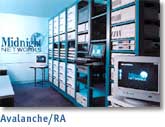
Voice Over IP is also one of many testing issues addressed by Midnight Networks, whose Avalanche and ANVL network testing products enjoyed great success in 1998. Three new products were introduced during the year: NetStorm, which tests VoIP gateways, Avalanche/WEB, a performance tester for ftp and http servers, and Avalanche/PCON, a network stress and capacity tester. In addition, Midnight introduced new releases of its Avalanche/LW and Avalanche/RA products, as well as a number of new test suites for ANVL. Avalanche/RA, which simulates hundreds of remote network clients (end users) to test the networkÕs ability to function under stress, has become an industry standard for product qualification, and industry analysts regularly trek to Midnight’s 384-port test bed to conduct comparative evaluations of new products. (This test bed, an impressive array of 17 Avalanche/RA units running 384 modem ports along with some very sophisticated software, was obviously not impressive enough for one large telecommunications manufacturer, which purchased its own 1344-port array, giving Midnight the largest single order in its history.) ANVL, meanwhile, continued to grow in popularity as a tester of various Internet protocols (formats through which one device “talks” to another over a network) including BGP4, PPTP, L2TP, IPSEC, IGMP, and DVMRP. At year-end, more than 100 customers, including most of the leading telecommunications equipment manufacturers, were using ANVL in their operations.
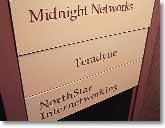
Midnight Networks, one of Teradyne’s more exciting entrepreneurial ventures, has now spawned its own spin-off, NorthStar Internetworking, which will work closely with our Telecommunications Division to develop new broadband test capabilities.
It is clear that the face of commerce is being changed radically and irreversibly by the World-Wide Web. In the past year thousands of companies have moved from simple “brochure-ware” Web sites to complex business-transaction sites, and on the heels of this explosion have come horror stories telling of Web-site outages and performance problems. RSW Software is a direct beneficiary of the “e-boom” and its growing pains, as its e-TEST suite of Web-testing products (e-Load, e-Tester, e-Monitor) are eagerly snapped up by companies whose business depends on the performance of their Web sites. Other companies are tackling the Web-testing problem, of course, but the RSW products are widely preferred for their versatility, low cost, and especially their ease of use. (A new customer can have the e-TEST suite up and running in an hour.) As 1998 progressed, demand for RSW’s test suite skyrocketed, with sales doubling from quarter to quarter. To handle the soaring volume, RSW resorted to — what else? — the Web, drawing inquiries via its (thoroughly tested) Web site, selling over the telephone, and downloading products to customers. At the end of its first full year of operation, RSW’s fast-growing customer list included banks, brokerages, retailers, mutual funds, insurance companies, utilities, accounting firms, real-estate brokers, colleges, and recruiting firms — some of which were very large companies, others small companies counting on the Web to make them large companies.
The financial services industry spends billions of dollars each year to buy “enterprise” software packages tailored to their applications (stock and mutual fund clearing, insurance policy administration, banking transactions, etc.), and they then spend billions more to test and deploy these specialized packages. This is the world in which Teradyne’s Softbridge operates. In 1998, its first full year under the Teradyne banner, Softbridge shifted its product strategy, which had centered on the sale of generalized test tools, to a more focused effort to supply specialized test products and services linked to some of the leading software packages used by industry. The insurance industry was an early target, and important contributors to Softbridge’s 1998 sales were products based on its partnership with Policy Management Systems Corporation, a major supplier of software to that industry. For example, TestAdvantage for CyberLife¨, tailored to a PMSC package, was purchased by a number of leading insurance companies to ensure the viability of their policy administration systems during initial deployment and on an ongoing basis thereafter. Softbridge left its Cambridge birthplace in 1998 in favor of larger quarters in Burlington, Massachusetts.
Sales at Systems and Software Test (SST) grew by 80 percent in 1998, most of the business coming from telecommunications equipment makers purchasing SST’s TestMaster, a software package that enables users to model their software with relative ease and then use the model to generate tests that accelerate product development. The latest version of the product, TestMaster 1.87, was shipped at year-end. SST also launched a new product line with the introduction of SuiteMaster, a graphics package that allows users to manipulate the Hammer IT tester via pick-and-place computer icons. A follow-on product, Hammer-CallMaster, will serve as a test-generating front end for the Hammer line. The growing acceptance of TestMaster in the telecommunications community gave SST its first European sales in 1998, and an office in Europe will soon join the groupÕs teams in Nashua, Chicago, and California.