

















 ur Connection Systems Division
was once again one of the Company’s stellar performers, as sales
increased to a record level, as they have in almost every year of the
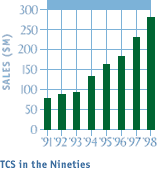
Division’s history. The 19-percent gain in 1998, to $280 million,
brought the Division’s compound growth rate over the past five years
down (!) to 25 percent, but it was enough to produce a gain in market
share.
ur Connection Systems Division
was once again one of the Company’s stellar performers, as sales
increased to a record level, as they have in almost every year of the
Division’s history. The 19-percent gain in 1998, to $280 million,
brought the Division’s compound growth rate over the past five years
down (!) to 25 percent, but it was enough to produce a gain in market
share.
Telecommunications systems once again led the list of market sectors served, with makers of data storage and computer systems not far behind. A number of important new accounts were brought aboard during 1998, and the TCS customer list now includes most of the major suppliers of switching systems, modems, routers, servers, and disk arrays, as well as several large computer makers and military systems contractors.
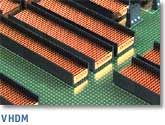
The leading revenue producers at TCS were once again the HD+ and HDM connectors and backplanes equipped with these connectors, but a new connector, VHDM, in its first full year of volume production, drew much of the market’s attention with its 2.5-gigabit/second performance and 100-contact-per-inch density. In the course of the year, the VHDM sales and marketing team competed for 31 design-ins, winding up with a record of 31 and 0.
The VHDM connector was also a noteworthy product of two of Teradyne’s more powerful management tools. The use of “Voice of the Customer” survey techniques helped create the right product, and the RPD (Revolutionizing Product Development) process helped bring it to market at the right time. “I’ve never seen a product start-up that smooth,” says TCS Manager Rick Schneider.
“We came out of the box with yields far higher than we could ever achieve in the past.”
Not long ago, TCS was known principally as a supplier of backplanes to the aerospace/defense industry. Much has occurred on other fronts since then, but this market remains a key part of the customer base. Among the notable space projects incorporating TCS backplanes in 1998 were several satellite systems, including Iridium and the new International Space Station.
Despite the addition of an 80,000 square-foot plant in Nashua in 1997, TCS found itself again strapped for space in 1998, and expansion was undertaken at several sites. The printed-circuit facility in Nashua added 94,000 square feet, including a new Class 10,000 clean room to safeguard the quality of its very large printed-circuit backplanes. (Among its 1998 shipments: a 64-layer board for a major telecommunications manufacturer.) A new 29,000-square-foot plant in Milpitas, California began serving a large Bay Area maker of networking equipment, not only producing parts for this customer but managing inventory and shipping to the customer’s factory within one hour of request. Including the Division’s main Nashua plant and its highly successful operation in Dublin, Ireland, TCS now has more than 600,000 square feet of manufacturing space under its control. Customers seeking HDM and VHDM connectors can also tap the capacity of second-source Molex.