|

Summary
In 2001, the Company continued its history of meeting customer
needs through technological innovation, customer intimacy, and manufacturing
excellence. Manufacturing capacity expansion continued via internal
investment, business unit acquisition, and an internal focus on
manufacturing efficiency. Capital expenditures for 2001 were $117.5
million compared to $100.4 million in 2000 and $137.4 million in
1999. This three-year period reflects a continuation of the Company’s
focus on building and expanding its manufacturing capacity to support
its technological strengths. In addition to this capital investment,
the Company also invested in strategic business acquisitions. During
the past five-years the Company has invested more than $1.0 billion
in capacity and capability improvements through capital expenditures
and business unit acquisitions.
During 2001, the Company successfully integrated new strategic businesses
acquired during 2001 and the latter half of 2000, while maintaining
profit margins and customer service levels during the transition.
Capacity has been added where growth opportunities are imminent,
and manufacturing improvements have been made in the pressure sensitive
materials business which are expected to lead to improved results
in 2002.
On September 7, 2001, the Company purchased all outstanding stock
of Duralam, Inc., which had annual sales of approximately $55.0
million, for a cash purchase price of $68.4 million. Duralam manufactures
films for packaging meat, cheese, candy, and other food products
at facilities in Appleton and Neenah, Wisconsin. The total cash
purchase price has been accounted for under the purchase method
of accounting in accordance with Statement of Financial Accounting
Standard (SFAS) Nos. 141 and 142 which discusses accounting treatment
for acquisitions initiated after June 30, 2001.
On July 19, 2001, the Company purchased the land, building, and
manufacturing equipment of the Prattville, Alabama facility of Wright
Plastics that had been closed earlier in 2001. The added capacity
provided by this modern manufacturing facility is used to produce
polyethylene packaging products.
Overall results for 2001 produced net sales of $2.29 billion compared
to $2.16 billion and $1.96 billion in 2000 and 1999, respectively.
The net sales increase of 5.9 percent in 2001 was led by volume
growth in the Flexible Packaging Segment’s high barrier products
principally due to business unit acquisitions made in the third
quarters of 2001 and 2000. Net income for 2001 totaled $140.3 million
compared with $130.6 million and $114.8 million for 2000 and 1999
respectively. Diluted earnings per share were $2.64 for 2001, $2.44
for 2000, and $2.18 for 1999. Excluding the effects of business
acquisitions and dispositions, 2001 net sales decreased 1.9 percent
from 2000.
Net sales for the Flexible Packaging segment increased 8.6 percent
with operating profits increasing 23.4 percent from the levels achieved
in 2000. Strong sales increases in high barrier products, further
supported by polyethylene and paper products, provided the base
for improved operating profits. Flexible Packaging operating profits
were $273.2 million in 2001, or 15.2 percent of net sales, compared
to $221.3 million, or 13.3 percent of net sales in 2000, and $187.2
million, or 12.7 percent of net sales in 1999. A continuing focus
on lowering costs and developing unique products to meet customer
needs largely account for the improvements in operating profit.
Net sales for the Pressure Sensitive Materials segment decreased
2.9 percent below the 2000 level. The weakened economy and general
overcapacity in the pressure sensitive materials industry have impacted
sales in this business segment throughout 2001. Operating profit
decreased 69.9 percent as this business segment continued to face
less favorable economic conditions in North America and increased
price competition in certain markets. Pressure Sensitive Materials
operating profits were $12.1 million in 2001, or 2.5 percent of
net sales, compared to $40.1 million, or 7.9 percent of net sales
in 2000, and $44.3 million, or 9.0 percent of net sales in 1999.
Return to Top
Outlook
In 2001, the successful integration of strategic acquisitions made
during 2001 and the second half of 2000 further strengthened the
Company’s core capabilities and capacity to better meet the
ever changing needs of our growing customer base. The Company’s
goal is for sales to rise six to eight percent annually. During
the next several years we expect the Flexible Packaging business
to benefit from continuing trends such as flexible packaging replacing
rigid packaging, enhanced product protection, end-user convenience,
product presentation, easy-to-handle features, and the unitization
of single-pack to multi-pack as well as from the ongoing consolidation
of customers with which the Company has strong relationships. Future
acquisitions could further enhance sales growth. In 2002, industrial
markets are expected to remain weak. These markets are served primarily
by our Pressure Sensitive Materials business and portions of our
polyethylene packaging product line. The Company expects, however,
that with greater than 65 percent of our products used in the food
industry, our exposure to this market limits the adverse impact
of any downturn in the economy.
Return to Top
Costs and Expenses
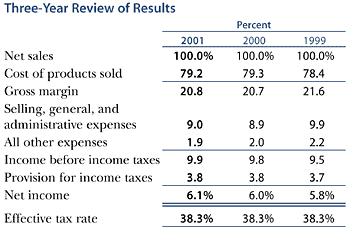
Cost of products sold as a percentage of net sales was 79.2 percent
for 2001 compared to 79.3 percent for 2000 and 78.4 percent for
1999. The increase experienced in 2000 was due to increasing material
costs which were partially offset by lower product conversion costs
and employee benefit costs.
Selling, general, and administrative expenses increased $14.9 million
in absolute dollars in 2001 versus 2000 after decreasing $1.5 million
in 2000 versus 1999. The 2001 increase is principally due to business
unit acquisitions during the third quarters of 2001 and 2000. Expressed
as a percent of net sales, selling, general, and administrative
expenses were 9.0 percent, 8.9 percent, and 9.9 percent for 2001,
2000, and 1999, respectively. The Company’s focus on improved
cost control together with lower employee benefit costs largely
accounted for the improvements achieved in 2000.
Research and development expense was $10.3 million in 2001, $10.1
million in 2000, and $11.7 million in 1999. This expense for the
Flexible Packaging segment increased $1.2 million in 2001 reflecting
continued commitment to product development. Within the Pressure
Sensitive Materials segment this expense decreased $1.0 million
as the primary focus was directed at improving operational efficiency.
Lower interest rates more than offset the impact of higher average
debt levels to lower 2001 interest expense to $30.3 million compared
to $31.6 million in 2000 and $21.2 million in 1999. Business unit
acquisitions and common stock repurchases during 2000 resulted in
increased debt levels and associated interest expense compared to
1999.
Other costs reflect expense of $1.9 million for 2001 versus expense
of $1.4 million and $6.9 million in 2000 and 1999, respectively.
The 1999 expense was principally due to losses from our Brazilian
joint venture that included $1.7 million for currency losses and
$2.6 million for relocation and reorganization costs. The results
in 2000 reflect both improved operating performance and reduced
currency effects. The increased expense in 2001 results from a loss
attributable to our Brazilian joint venture.
The year 2000 reduction in minority interest is due to the January
2000 purchase of the 13 percent minority interest in MACtac. Upon
the acquisition of these minority shares, MACtac became a wholly-owned
subsidiary of Bemis Company, Inc.
Return to Top
Return on Investment
Return on average stockholders’ equity in 2001 was 16.7 percent
compared to 17.1 percent in 2000 and 16.2 percent in 1999. Operating
profit as a percent of average investment was 17.5 percent in 2001
compared to 16.8 percent in 2000 and 18.6 percent in 1999.
Operating profit as a percent of average investment for the Flexible
Packaging segment was 20.5 percent in 2001 compared to 17.2 percent
in 2000 and 18.6 percent in 1999. This same ratio for the Pressure
Sensitive Materials segment was 4.1 percent in 2001 compared to
14.6 percent in 2000 and 18.7 percent in 1999.
Return on average total capital was 10.0 percent in 2001, 10.8
percent in 2000, and 10.9 percent in 1999. Total capital is defined
as the sum of all short-term and long-term interest-bearing debt,
including obligations under capital leases, stockholders’ equity,
and deferred taxes. Return on total capital is based on net income
adjusted for interest expense on an after-tax basis.
Return to Top
Capital Expenditures
Capital expenditures in 2001 were $117.5 million compared to $100.4
million in 2000 and $137.4 million in 1999, including capitalized
interest of $0.2 million, $1.7 million, and $1.6 million for 2001,
2000, and 1999, respectively. In 2002, management anticipates expenditures
of approximately $105 million. The majority of these expenditures
are expected to be made from internally generated funds and will
be for continued expansion and enhancement of the Company’s
growth businesses.
Return to Top
|