|

New Accounting Pronouncements
In July 2001, the Financial Accounting Standards Board (FASB) issued
SFAS No. 141, “Business Combinations” and SFAS No. 142,
“Goodwill and Other Intangible Assets”. SFAS No. 141 requires
that the purchase method be used for business combinations initiated
after June 30, 2001. SFAS No. 142 requires that goodwill no longer
be amortized to earnings, but instead be reviewed for impairment.
The provisions of SFAS No. 142 are effective for fiscal years beginning
after December 15, 2001, and any business combination initiated
after June 30, 2001. In January of 2002, the Company will adopt
the reporting requirements of SFAS No. 142 and has already applied
its requirements to the purchase of Duralam, Inc. which was completed
on September 7, 2001. Based upon the Company’s assessment of
recorded goodwill and intangible assets, had the standard been in
effect January 1, 2001, the Company estimates that the full year
2001 impact would have been approximately $0.17 of additional diluted
earnings per share. In lieu of amortization, the Company will be
required to perform an initial impairment review of its goodwill
in 2002 and an annual impairment review thereafter. The Company
expects to complete this initial review by June 30, 2002.
In July 2001, the FASB also issued SFAS No. 143, “Accounting
for Asset Retirement Obligations” which provides accounting
requirements for retirement obligations associated with tangible
long-lived assets. SFAS No. 143 is effective for fiscal years beginning
after June 15, 2002. Management believes the adoption of SFAS No.
143 will not have a material impact on the Company’s financial
position or results of operations.
In October 2001, the FASB issued SFAS No. 144, “Accounting
for Impairment of Long-Lived Assets”. SFAS No. 144, effective
for financial statements for fiscal years beginning after December
15, 2001, addresses issues relating to the implementation of SFAS
No. 121, “Accounting for the Impairment of Long-Lived Assets
and for Long-Lived Assets to be Disposed Of”, and develops
a single accounting model for long-lived assets to be disposed of
by sale, whether previously held and used or newly acquired. Based
on management’s assessment, the adoption of SFAS No. 144 will
not have a material impact on the Company’s financial position
or results of operations.
Effective January 1, 2001, the Company adopted SFAS No. 133, “Accounting
for Derivative Instruments and Hedging Activities,” as amended
by SFAS Nos. 137 and 138. This new accounting standard requires
that all derivative instruments be recorded on the balance sheet
at fair value and establishes criteria for designation and effectiveness
of hedging relationships. The effect of adopting this standard was
not material to the Company’s consolidated financial statements.
Upon adoption, the Company recorded the immaterial impact as interest
expense.
Market Prices and Dividends
The Bemis quarterly dividend was increased by 4.2 percent in the
first quarter of 2001 to 25 cents per share from 24 cents. This
followed first quarter increases of 4.3 percent in 2000 to 24 cents
per share from 23 cents, and 4.5 percent in 1999 to 23 cents per
share from 22 cents in 1998.
Common dividends for 2001 were $1.00 per share, up from 96 cents
in 2000 and 92 cents in 1999. The 2001 dividend payout ratio was
37.9 percent compared to 39.3 percent in 2000 and 42.2 percent in
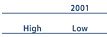
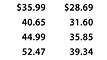
1999. Based on the market price of $33.56 per share at the end of
2000, the dividend yield was 3.0 percent.
Stockholders’ equity per common share (book value per share)
increased to $16.76 per share in 2001, up from $15.18 per share
in 2000 and $13.91 per share in 1999. Trading volume in Bemis common
stock was 43.8 million shares in 2001.
In January 2002, the Board of Directors increased the quarterly
cash dividend on common stock to 26 cents per share from 25 cents,
a 4.0 percent increase.
Return to Top
Critical Accounting Policies and Estimates
Management’s discussion and analysis of its financial condition
and results of operations are based upon the Company’s consolidated
financial statements, which have been prepared in accordance with
accounting principles generally accepted in the United States. The
preparation of these financial statements requires management to
make estimates and assumptions that affect the reported amounts
of assets and liabilities and the disclosure of contingent assets
and liabilities at the date of the financial statements and the
reported amounts of revenues and expenses during the reporting period.
On an on-going basis, management evaluates its estimates and judgements,
including those related to customer incentives, product returns,
doubtful accounts, inventories, investments, intangible assets,
income taxes, financing operations, retirement benefits, and contingencies
and litigation. Management bases its estimates and judgements on
historical experience and on various other factors that are believed
to be reasonable under the circumstances, the results of which form
the basis for making judgements about the carrying values of assets
and liabilities that are not readily apparent from other sources.
Actual results may differ from these estimates under different assumptions
or conditions. Management believes the following critical accounting
policies affect its more significant judgements and estimates used
in the preparation of its consolidated financial statements.
Revenue recognition, including customer based programs
and incentives Estimating valuation allowances and accrued liabilities,
specifically sales returns and allowances, the allowance for doubtful
accounts, reserves for old, excess, or potentially obsolete inventory,
and litigation and environmental accruals The determination of actuarially determined liabilities
related to pension plans, other postretirement benefit obligations,
and self-insurance reserves Accounting for income taxes Valuation and useful lives of long-lived and intangible
assets and goodwill Determining functional currencies for the purpose of consolidating
our international operations
The Company recognizes sales and costs of sales at the time title
transfers to the customer which is generally when product is shipped.
Approximately one percent of sales may be recognized prior to
shipment as a result of customers’ request necessitated by
the customers’ changing business conditions. The Company
records estimated reductions to revenue for customer programs
and incentive offerings including special pricing agreements,
promotions, and other volume-based incentives. If market conditions
were to decline, the Company may take actions to increase customer
incentive offerings, possibly resulting in a reduction of gross
profit margins at the time the incentive is offered.
Management estimates sales returns and allowances by analyzing
historical returns and credits and known problems to calculate
appropriate reserves for future credits. Management estimates
the allowance for doubtful accounts by analyzing accounts receivable
balances by age, applying historical trend rates to the most recent
12 months’ sales, less actual write-offs to date. When it
is deemed probable that a customer account is uncollectible, that
balance is added to the calculated reserve. Actual results could
differ from these estimates under different assumptions.
Management’s current estimated ranges of liabilities related
to the pending litigation and environmental claims are based on
management’s best estimate of future costs. While the final
resolution of the litigation and environmental contingencies could
result in amounts different than current accruals, and therefore
have an impact on the Company’s consolidated financial results
in a future reporting period, management believes the ultimate outcome
will not have a significant effect on the Company’s consolidated
results of operations, financial position or cash flows.
Return to Top
Pension and other postretirement benefit obligations are actuarially
determined. This calculation includes assumptions related to the
discount rate, projected salary increases, and the expected return
on assets. The Company is self-insured in North America for most
workers compensation, general liability and automotive liability
losses subject to per occurrence and aggregate annual liability
limitations. The Company is also self-insured for health care
claims for eligible participating employees subject to certain
deductibles and limitations. The Company determines its liabilities
for claims incurred but not reported on an actuarial basis. A
change in these assumptions could cause actual results to differ
from those reported.
Judgment by management is required in determining the provision
for income taxes and deferred tax assets and liabilities. As part
of the process of preparing the Company’s consolidated financial
statements, management is required to estimate income taxes in
each of the jurisdictions in which the Company operates. This
process involves estimating actual current tax exposure together
with assessing temporary differences resulting from differing
treatment of items for tax and accounting purposes. These differences
result in deferred tax assets and liabilities, which are included
within the Company’s consolidated balance sheet. Management
must then assess the likelihood that deferred tax assets will
be recovered from future taxable income and to the extent management
believes that recovery is not likely, a valuation allowance must
be established.
Management periodically reviews its long-lived assets, intangible
assets, and goodwill for impairment and assesses whether significant
events or changes in business circumstances indicate that the
carrying value of the assets may not be recoverable. An impairment
loss is recognized when the carrying amount of an asset exceeds
the anticipated future cash flows expected to result from the
use of the asset and its eventual disposition. The amount of the
impairment loss to be recorded, if any, is calculated by the excess
of the asset’s carrying value over its fair value. Management
also periodically reassesses the estimated remaining useful lives
of its long-lived assets. Changes to estimated useful lives would
impact the amount of depreciation and amortization expense recorded
in earnings.
In 2002, SFAS No. 142, “Goodwill and Other Intangible Assets”
became effective and as a result, the Company will cease to amortize
goodwill in 2002. Had this standard been in effect on January
1, 2001, the Company estimates the impact of not amortizing historical
goodwill to be an after-tax benefit of approximately $9.3 million,
or $0.17 per diluted share for the year ended December 31, 2001.
In lieu of amortization, the Company will be required to perform
an initial impairment review of its goodwill in 2002 and an annual
impairment review thereafter. The Company expects to complete
this initial review by June 30, 2002.
In preparing the consolidated financial statements, the Company
is required to translate the financial statements of its foreign
subsidiaries from the currency in which they keep their accounting
records, generally the local currency, into United States dollars.
Assets and liabilities of these operations are translated at the
exchange rates in effect at each fiscal year end. The translation
adjustments related to assets and liabilities that arise from
the use of differing exchange rates from period to period are
included in accumulated other comprehensive income in shareholders’
equity. Income statement accounts are translated at the average
rates of exchange prevailing during the year. The different exchange
rates from period to period impact the amount of reported income
from the Company’s international operations.
Return to Top
Forward-Looking Statements
This Annual Report contains certain estimates, predictions, and
other “forward-looking statements” (as defined in the
Private Securities Litigation Reform Act of 1995, and within the
meaning of Section 27A of the Securities Act of 1933, as amended,
and Section 21E of the Securities Act of 1934). The words “believe,”
“expect,” “anticipate,” “intend,”
“estimate,” “target,” “may,” “will,”
“plan,” “project,” “should,” “continue,”
or the negative thereof or other similar expressions, or discussion
of future goals or aspirations, which are predictions of or indicate
future events and trends and which do not relate to historical matters,
identify forward-looking statements. Such statements are based on
information available to management as of the time of such statements
and relate to, among other things, expectations of the business
environment in which the Company operates, projections of future
performance, perceived opportunities in the market, and statements
regarding the Company’s mission and vision. Forward-looking
statements involve known and unknown risks, uncertainties, and other
factors, which may cause the actual results, performance, or achievements
of the Company to differ materially from anticipated future results,
performance, or achievements expressed or implied by such forward-looking
statements. The Company undertakes no obligation to publicly update
or revise any forward-looking statement, whether as a result of
new information, future events, or otherwise.
Factors that could cause actual results to differ from those expected
include, but are not limited to, general economic conditions such
as inflation, interest rates, and foreign currency exchange rates;
results from acquisitions may differ from what the Company anticipates;
competitive conditions within the Company’s markets, including
the acceptance of new and existing products offered by the Company;
price changes for raw materials and the ability of the Company to
pass these price changes on to its customers or otherwise manage
commodity price fluctuation risks; the presence of adequate cash
available for investment in the Company’s business in order
to maintain desired debt levels; unanticipated consequences of the
European Monetary Union’s conversion to the euro; changes in
governmental regulation, especially in the areas of environmental,
health and safety matters, and foreign investment; unexpected outcomes
in the Company’s current and future litigation proceedings;
and changes in the Company’s labor relations. These and other
risks, uncertainties, and assumptions identified from time to time
in the Company’s filings with the Securities and Exchange Commission,
including without limitation, its Annual Report on Form 10-K and
its quarterly reports on Form 10-Q, could cause the Company’s
actual future results to differ materially from those projected
in the forward-looking statements. In addition, the Company’s
actual future results could differ materially from those projected
in the forward-looking statement as a result of changes in the assumptions
used in making such forward-looking statements.
Return to Top
|