|

Long-term debt maturing in years 2002 through 2006 is $3,572,000,
$658,000, $640,000, $100,855,000, and $229,100,000, respectively.
Under the terms of a revolving credit agreement with five banks,
the Company may borrow up to $334 million through August 1, 2006.
The Company currently pays a facility fee of .12 percent annually
on the entire amount of the commitment. In addition to the revolving
long-term credit agreement, the Company has a 364-day bridge credit
agreement with six banks under which it may borrow up to $250 million.
The Company pays a facility fee of .10 percent annually on the entire
amount of the commitment. There were no borrowings outstanding under
these agreements at December 31, 2001. These credit facilities are
used primarily to support the Company’s issuance of commercial
paper.
During the third quarter 2001, to obtain greater exposure to short-term
floating interest rates, the Company entered into long-term interest
rate swap agreements for a total notional amount of $350.0 million
with three major U.S. banks. These interest rate swap agreements
have been designated as hedges of changes in the fair value of the
Company’s $350.0 million fixed rate long-term debt obligations
($100.0 million, 6.7 percent notes due July 1, 2005, and $250.0
million, 6.5 percent notes due August 15, 2008). Counterparties
to these agreements are major U.S. banks who also participate in
the Company’s bank credit facilities. Credit loss from counterparty
nonperformance is not anticipated.
Debt consisted of the following at December 31,
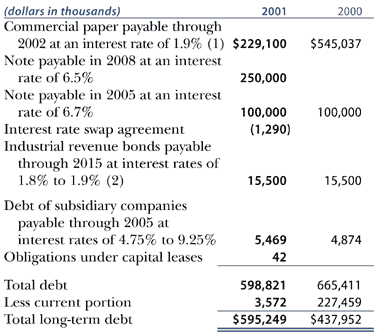
The commercial paper has been classified as long-term debt,
to the extent of available long-term backup credit agreements,
in accordance with the Company’s intention and ability to
refinance such obligations on a long-term basis. The interest
rate of commercial paper outstanding at December 31, 2001, was
1.9 percent. The maximum outstanding during 2001 was $561,439,000,
and the average outstanding during 2001 was $418,026,000. The
weighted-average interest rate during 2001 was 4.3 percent. - Two industrial revenue bonds for which the variable interest
rate is determined weekly by a “Remarketing Agent” based
on similar debt then available. The weighted-average interest
rate at December 31, 2001 was 1.8 percent. The weighted-average
interest rate during 2001 was 2.9 percent.
Under these interest rate swap agreements the Company will receive
a fixed rate of interest and pay a variable rate of interest over
the term without the exchange of the underlying notional amounts.
The fixed rate of interest, which the Company will receive, is equal
to the interest rate of the Company’s long-term debt which
is being hedged. The variable rate of interest which the Company
will pay is based on the six-months London Interbank Offered Rate
(LIBOR), set in arrears, plus a fixed spread which is unique to
each agreement. The variable rates are reset semiannually at each
net settlement date. At December 31, 2001, the net settlement receivable
of $4.0 million was recorded as a reduction in interest expense.
The terms of the interest rate swap agreements have been specifically
designed to conform with the applicable terms of the hedged items
and with the requirements of paragraph 68 of SFAS No. 133 to support
the assumption of no ineffectiveness (changes in fair value of the
debt and the swaps exactly offset) and to simplify the computations
necessary to make the accounting entries. At December 31, 2001,
the fair value of these interest rate swaps was $1.3 million in
the banks’ favor, as determined by the respective bank using
discounted cash flow or other appropriate methodologies, and is
included with other liabilities and deferred credits with a corresponding
decrease in long-term debt.
Return to Top
|