|

Principles of consolidation:
The consolidated financial statements include the accounts of the
Company and its majority owned subsidiaries. All significant intercompany
transactions and accounts have been eliminated in consolidation.
Revenue recognition: Sales and
related cost of sales are recognized primarily upon shipment of
products. Approximately one percent of sales were recognized prior
to shipment as a result of customers’ request necessitated
by the customers’ changing business conditions. In all such
instances the Company has accounted for these transactions in accordance
with U.S. generally accepted accounting principles as well as the
Securities and Exchange Commission’s Staff Accounting Bulletin
No. 101.
Research and development: Research
and development expenditures are expensed as incurred.
Earnings per share: Basic earnings
per common share are computed by dividing net income by the weighted-average number of
common shares outstanding during the year. Diluted earnings per
share are computed by dividing net income by the weighted-average
number of common shares outstanding during the year including common
stock equivalents, if dilutive.
Inventory valuation: Inventories
are valued at the lower of cost, determined by the first-in, first-out
(FIFO) method, or market.
Return to Top
Property and equipment: Property
and equipment are stated at cost. Plant and equipment are depreciated
for financial reporting purposes principally using the straight-line
method over the estimated useful lives of assets as follows: land
improvements, 15-30 years; buildings, 15-45 years; leasehold and building improvements,
8-20 years; and machinery and equipment, 3-16 years. For tax purposes,
the Company generally uses accelerated methods of depreciation.
The tax effect of the difference between book and tax depreciation
has been provided as deferred income taxes. On sale or retirement,
the asset cost and related accumulated depreciation are removed
from the accounts and any related gain or loss is reflected in income.
Maintenance and repairs that do not improve efficiency or extend
economic life are expensed currently. Interest costs are capitalized
for major capital expenditures during construction.
Goodwill: Goodwill represents
the excess of cost over net assets of businesses acquired. Goodwill
acquired prior to 1971 is not amortized against income unless a
loss of value becomes evident. Goodwill resulting from investments
made subsequent to 1970 is amortized against income using the straight
line method over various periods ranging from 20 to 40 years. The
Company periodically reviews goodwill for impairment and assesses
whether significant events or changes in business circumstances
indicate that the carrying value of the assets may not be fully
recoverable. Recoverability is assessed by comparing anticipated
undiscounted future cash flows from operations to net book value.
In January of 2002, the Company will adopt the reporting requirements
of Statement of Financial Accounting Standards (SFAS) No. 141, “Business
Combinations” and SFAS No. 142, “Goodwill and Other Intangible
Assets” and, as required for acquisitions after June 30, 2001,
has already applied its requirements to the purchase of Duralam,
Inc. which was completed on September 7, 2001.
Return to Top
Intangible assets: Intangible
assets are being amortized against income using the straight line
method over their estimated useful lives, with periods ranging up
to 20 years. The Company periodically reviews intangible assets
for impairment and assesses whether significant events or changes
in business circumstances indicate that the carrying value of the
assets may not be fully recoverable. Recoverability is assessed
by comparing anticipated undiscounted future cash flows from operations
to net book value.
Taxes on undistributed earnings:
No provision is made for U.S. income taxes on earnings of non-U.S.
subsidiary companies which the Company controls but does not include
in the consolidated federal income tax return since it is management’s
practice and intent to permanently reinvest the earnings.
Translation of foreign currencies:
Assets and liabilities are translated at the exchange rate as of
the balance sheet date. All revenue and expense accounts are translated
at average exchange rates in effect during the year. Translation
adjustments are recorded as a separate component of equity.
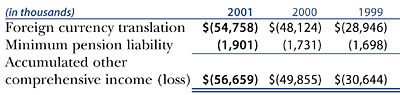
Accumulated other comprehensive income
(loss): The components of accumulated other comprehensive
income (loss) are as follows as of December 31:
Statement of Cash Flows: For purposes of reporting
cash flows, cash includes cash on hand and demand deposit accounts.
Preferred Stock Purchase Rights:
On July 29, 1999, the Company’s Board of Directors adopted
a Shareholder Rights Plan by declaring a dividend of one preferred
share purchase right for each outstanding share of common stock.
Under certain circumstances, a right may be exercised to purchase
one two-hundredth of a share of Series A Junior Preferred Stock
for $120, subject to adjustment. The rights become exercisable if,
subject to certain exceptions, a person or group acquires beneficial
ownership of 15 percent or more of the Company’s outstanding
common stock or announces an offer which would result in such person
acquiring beneficial ownership of 15 percent or more of the Company’s
outstanding common stock. If a person or group acquires beneficial
ownership of 15 percent or more of the Company’s outstanding
common stock, subject to certain exceptions, each right will entitle
its holder to buy common stock of the Company having a market value
of twice the exercise price of the right. The rights expire August
23, 2009, and may be redeemed by the Company for $.001 per right
at any time before a person becomes a beneficial owner of 15 percent
or more of the Company’s outstanding common stock. The Company’s
Board of Directors has designated 600,000 shares of Series A Junior
Preferred Stock with a par value of $1 per share that relate to
the Shareholder Rights Plan. At December 31, 2001, none of these
shares were issued or outstanding.
Return to Top
Financial Instruments: In June
1998, the Financial Accounting Standards Board (FASB) issued SFAS
No. 133, “Accounting for Derivative Instruments and Hedging
Activities.” This statement, as amended, establishes standards
for recognition and measurement of derivatives and hedging activities
and requires that all derivative instruments be recorded on the
balance sheet at fair value. The fair value of all derivative instruments,
such as forward foreign currency exchange contracts and interest
rate swap arrangements are recorded. Implementation of this standard
as required on January 1, 2001, did not have a material effect on
the Company’s financial position or results of operation.
Environmental cost: The Company
is involved in a number of environmental related disputes and claims.
The Company accrues for environmental costs when it is probable
that these costs will be incurred and can be reasonably estimated.
At December 31, 2001 and 2000, reserves were $778,000 and $401,000,
respectively. Adjustments to the reserve accounts and costs which
were directly expensed for environmental remediation matters resulted
in charges to the income statements for 2001, 2000, and 1999 of
$406,000, $183,000, and $2,046,000, net of third party reimbursements
totaling $5,000, $150,000, and $442,000, for 2001, 2000, and 1999,
respectively.
Estimates and assumptions required:
The preparation of financial statements in conformity with U.S.
generally accepted accounting principles requires management to
make estimates and assumptions that affect the reported amounts
of assets and liabilities at the date of the financial statements
and the reported amounts of revenues and expenses during the reporting
period. Actual results could differ from those estimates.
Return to Top
|