|

Capital Structure, Liquidity, and Cash Flow
Stockholders’ equity increased in 2001 to $886.1 million,
up from $798.8 million in 2000 and $725.9 million in 1999, primarily
due to earnings reduced by dividend payments and common stock repurchases.
In 2001, $1.2 million of common stock was repurchased compared to
$42.8 million in 2000 and $4.1 million in 1999. Common stock totaling
$7.9 million and $0.48 million was issued in 2001 and 2000, respectively,
in connection with the Company’s stock-based compensation programs.
Additionally, common stock totaling $54.8 million was issued in
2000 in connection with the acquisition of the minority interest
of MACtac.
Total debt decreased $70.3 million in 2001 to $600.9 million,
resulting in a total debt to total capital ratio of 37.3 percent
compared to 42.7 percent in 2000 and 31.7 percent in 1999. The significant
debt increase in 2000 is due to business unit acquisitions and common
stock repurchases. In 2002, total debt is expected to decrease due
to continuing strong cash flow from operations.
On August 10, 2001, the Company completed the placement of $250.0
million of 6.5 percent Notes due August 15, 2008. The total proceeds
were used to pay-down outstanding commercial paper.
On September 6, 2001, to obtain greater exposure to short-term floating
interest rates, the Company entered into long-term interest rate
swap agreements for a total notional amount of $350.0 million with
three major U.S. banks. These interest rate swap agreements have
been designated as hedges of changes in the fair value of the Company’s
existing $350.0 million fixed rate long-term debt obligations.
Under these interest rate swap agreements the Company will receive
a fixed rate of interest and pay a variable rate of interest over
the term without the exchange of the underlying notional amounts.
The fixed rate of interest, which the Company will receive, is equal
to the interest rate of the Company’s long-term notes which
is being hedged. The variable rate of interest which the Company
will pay is based on the six-months London Interbank Offered Rate
(LIBOR), set in arrears, plus a fixed spread which is unique to
each agreement. The variable rates are reset semiannually at each
net settlement date. At December 31, 2001, the net settlement receivable
of $4.0 million was recorded as a reduction in interest expense.
This position for the Company would become less favorable as short-term
interest rates increase. At December 31, 2001, the fair value of
these interest rate swaps was $1.3 million in the banks’ favor
and is included with other liabilities and deferred credits with
a corresponding decrease in long-term debt.
The current ratio was 2.5:1 in 2001 compared to 1.3:1 in 2000 and
2.3:1 in 1999, reflecting the short-term debt increase in 2000 associated
with acquisitions, which was refinanced with long-term notes in
2001. Working capital (excluding short-term borrowings and the current
portion of long-term debt) decreased by $25.3 million to $354.4
million in 2001 following an increase of $42.6 million to $379.7
million in 2000 and an increase of $29.3 million to $337.1 million
in 1999.
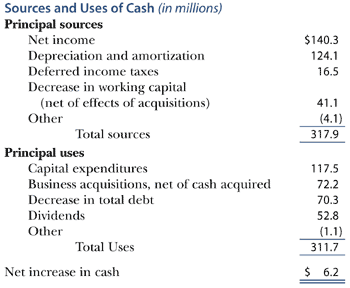
The Company’s cash flow remained strong in 2001 as cash provided
by operating activities was $317.9 million compared to $210.2 million
in 2000 and $186.1 million in 1999. The following schedule presents
the major sources and uses of cash for the Company in 2001.
The Company believes that cash generated by operating activities
together with cash available through commercial paper issuance will
be more than adequate to fund all of the requirements which are
reasonably foreseeable for 2002.
At year-end 2001, the Company had credit lines of $584 million,
including a $334 million revolving credit facility and a $250 million
short-term 364-day bridge credit facility. These lines are used
primarily to support the Company’s issuance of commercial paper
which carries an A-1, P-1 credit rating. The Company also has the
capability of issuing up to approximately $100 million of Extendable
Commercial Notes (ECNs) which are short-term instruments whose maturity
can be extended to 390 days from the date of issuance. As of December
31, 2001, the Company had $229 million of commercial paper outstanding.
The Company’s favorable credit rating is important to its ability
to issue commercial paper at favorable rates of interest. While
not anticipated, a downgrade in the Company’s credit rating
would increase the cost of borrowing and could limit the Company’s
ability to issue commercial paper and require the Company to draw
upon existing credit facilities.
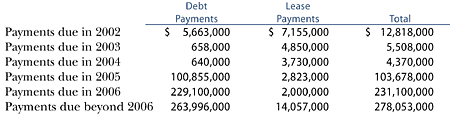
Cash required to meet the Company’s short-term and long-term
debt obligations and operating lease payments is summarized in the
following table:
Commercial paper outstanding at December 31, 2001, has been classified
as long-term debt, to the extent of available long-term backup credit
agreements which expire in 2006, in accordance with the Company’s
intention and ability to refinance such obligations on a long-term
basis.
The Company’s pretax interest coverage was 8.5 times in 2001
compared to 7.7 times in 2000 and 9.8 times in 1999. Pretax income
increased to $227.4 million in 2001 from $211.5 million in 2000
and $185.9 million in 1999. Interest expense was $30.3 million in
2001, $31.6 million in 2000, and $21.2 million in 1999. Following
are pretax interest coverage ratios for the last five years:

Return to Top
Market Risks and Foreign Currency Exposures
The Company enters into contractual arrangements (derivatives) in
the ordinary course of business to manage
foreign currency exposure and interest rate risks. The Company does
not enter into derivatives for trading purposes. The Company’s
use of derivatives is subject to internal policies that provide
guidelines for control, counterparty risk, and ongoing reporting
and is designed to reduce the income statement volatility associated
with movements in foreign exchange rates and to achieve greater
exposure to short-term interest rates.
During the third quarter 2001, to obtain greater exposure to short-term
floating interest rates the Company entered into long-term interest
rate swap agreements for a total notional amount of $350.0 million
with three major U.S. banks. Under these interest rate swap agreements
the Company will receive a fixed rate of interest and pay a variable
rate of interest over the term without the exchange of the underlying
notional amounts. At December 31, 2001, the net settlement receivable
of $4.0 million was recorded as a reduction in interest expense.
This position for the Company would become less favorable as short-term
interest rates increase.
These interest rate swap agreements have been designated as hedges
of changes in the fair value of the Company’s existing $350.0
million fixed rate long-term debt obligations. The terms of the
interest rate swap agreements have been specifically designed to
conform with the applicable terms of the hedged items and with the
requirements of paragraph 68 of SFAS No. 133 to support the assumption
of no ineffectiveness (changes in fair value of the debt and the
swaps exactly offset) and to simplify the computations necessary
to make the accounting entries. At December 31, 2001, the fair value
of these interest rate swaps was $1.3 million in the banks’
favor, as determined by the respective bank using discounted cash
flow or other appropriate methodologies, and is included with other
liabilities and deferred credits with a corresponding decrease in
long-term debt.
The Company’s international operations enter into forward foreign
currency exchange contracts to manage foreign currency exchange
rate exposures associated with certain foreign currency denominated
receivables and payables, principally for transactions in non-euro
zone countries. At December 31, 2001 and 2000, the Company had outstanding
forward foreign currency exchange contracts aggregating $3,166,000
and $7,270,000, respectively. The introduction of the “euro”
on January 1, 1999, by the European Economic and Monetary Union
has reduced the exposure to currency fluctuations among participating
countries resulting in reduced volume of forward foreign
currency exchange contracts. Forward foreign currency exchange contracts
generally have maturities of less than nine months and relate primarily
to major Western European currencies. Counterparties to the forward
foreign currency exchange contracts are major financial institutions.
Credit loss from counterparty nonperformance is not anticipated.
On January 1, 2001, SFAS No. 133, “Accounting for Derivative
Instruments and Hedging Activities,” was adopted by the Company.
SFAS No. 133 requires that the fair value of derivative instruments,
such as forward foreign currency exchange contracts, be recorded
on the balance sheet with subsequent changes reflected in income
or deferred as an element of equity. The Company has not designated
these derivative instruments as hedging instruments. The $6,600
net settlement expense (fair value) related to active forward foreign
currency exchange contracts is recorded on the balance sheet and as an expense element
of other costs (income), net.
The Company has a one-third interest in a Brazilian joint venture,
ITAP/Bemis Ltda. The joint venture has foreign denominated debt
exposures that are substantially hedged. Net conversion losses or
gains on the debt are recorded as an expense.
Return to Top
Income Taxes
The Company’s effective tax rate was 38.3 percent in 2001,
2000, and 1999. The difference between the Company’s overall
tax rate and the U.S. statutory tax rate of 35 percent in 2001,
2000, and 1999 principally relates to state and local income taxes
net of the federal income tax benefit.
Return to Top
|