|

The Company sponsors several defined benefit postretirement plans
that cover a majority of salaried and a portion of nonunion hourly
employees. These plans provide health care benefits and, in some
instances, provide life insurance benefits. Except for one closed-group
plan, which is noncontributory, postretirement health care plans
are contributory, with retiree contributions adjusted annually;
life insurance plans are noncontributory.
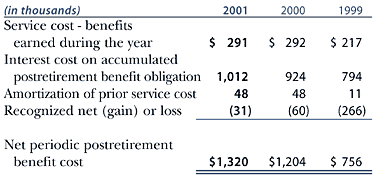
Net periodic postretirement benefit costs included the following
components for the years ended December 31, 2001, 2000, and 1999.
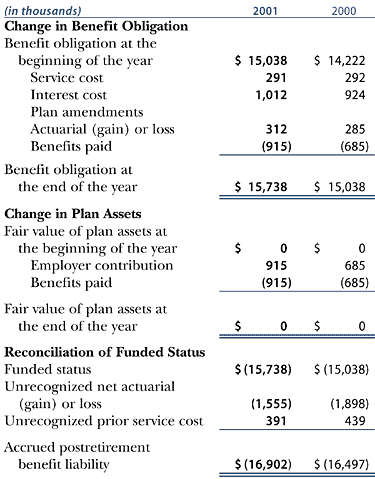
Changes in benefit obligation and plan assets, and a reconciliation
of the funded status at December 31, 2001 and 2000, are as follows:
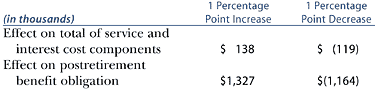
The health care cost trend rate assumption has a significant effect
on the amounts reported. A one-percentage point change in assumed
health care trends would have the following effects:
For measurement purposes, a 7.0 percent annual rate of increase
in the per capita cost of covered health care benefits was assumed
for 2001; the rate was assumed to decrease gradually to 5.5 percent
by the year 2003 and remain at that level thereafter. The weighted-average
discount rate used in determining the accumulated postretirement
benefit obligation was 7.0 percent in 2001 and 7.0 percent in 2000.
Return to Top
|